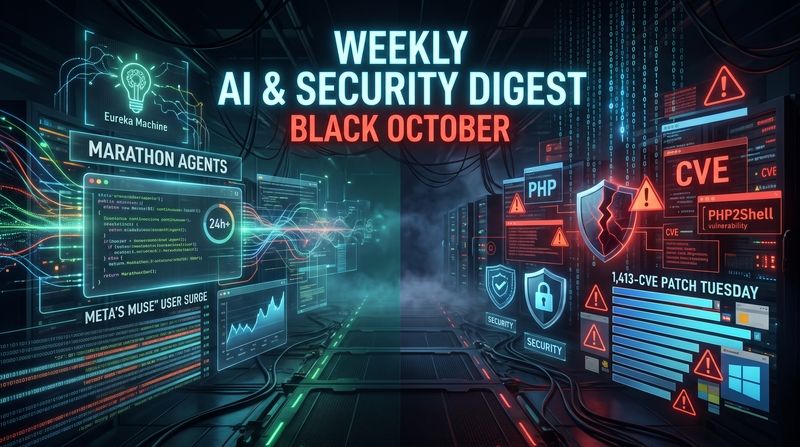
Welcome to your Sunday roundup of the most critical developments in artificial intelligence and digital security for the week ending October 25, 2026. This week, the theoretical risks of #Ai in cybersecurity became a stark reality, as AI tools uncovered massive, foundational vulnerabilities in the internet's most popular programming language, kicking off what experts are calling "Black October". Meanwhile, AI agents are evolving from quick chatbots to marathon workers capable of running tasks for days. Whether you are a casual reader or a seasoned systems architect, here is what you need to know for your week ahead.
Top AI Tech News This Week
1. Meta's "Muse" Outpaces ChatGPT's Early Growth
- The Basics (Common): Meta’s new personal artificial intelligence app, Muse, is a massive hit. It was downloaded over 10 million times in the U.S. in just 40 days, growing even faster than ChatGPT did when it first launched in America.
- Under the Hood (Intermediate): Muse is designed to remember user information and perform tasks autonomously, rather than just answering questions. Sensor Tower data shows the app quickly hit approximately 2.5 million daily active users with an impressive seven-day retention rate of 30%.
- The Deep Dive (Advanced): While the download metrics (10.2 million U.S. downloads) are staggering, they are heavily subsidized by Meta's ecosystem; Muse accounted for roughly 39% of Meta's own ad spend in October. The real test will be whether this heavily funded user acquisition translates into sustained, multi-turn agentic task delegation over the next quarter.
2. The Era of "Marathon" AI Agents Begins
- The Basics (Common): Artificial intelligence can now work on complex, multi-step projects for days at a time without needing a human to constantly guide it.
- Under the Hood (Intermediate): This week, Notion announced the sixth generation of its Notion Agent harness, allowing AI agents to work on single tasks for more than 24 hours, a massive jump from their previous five-minute limit. Similarly, Anthropic's science team used "Claude Science" to autonomously design scorpion-toxin binders during a continuous 64-hour run.
- The Deep Dive (Advanced): This leap from minutes to days fundamentally alters the economics of knowledge work. Notion's ability to support 24-hour agentic routing without raising seat prices signals that inference costs for long-horizon planning are plummeting. Anthropic's 64-hour protein-design campaign proves that frontier models can now maintain context windows and coherent reasoning chains over extended, unsupervised periods.
3. Automating AI Research with the "Eureka Machine"
- The Basics (Common): A company has successfully used a specialized AI system to automate the process of building *other* AI models, creating a powerful new coding assistant in under four months.
- Under the Hood (Intermediate): Recursive Superintelligence (Recursive SI) launched Flint, a new coding model built using their "Eureka Machine". The Eureka system helps automate hypothesis generation and model optimization, drastically speeding up the development timeline.
- The Deep Dive (Advanced): Flint utilizes a 40-billion parameter Mixture of Experts (MoE) architecture that runs efficiently on local hardware, generating over 125 tokens per second on a MacBook Pro. By automating the AI research pipeline, Recursive SI demonstrates that smaller, agile teams can now produce highly competitive, specialized models without relying on massive, traditional research labs.
Top Digital Security News This Week
1. "Black October" and the AI-Discovered PHP Vulnerability
- The Basics (Common): The internet is facing a massive crisis. AI tools discovered incredibly deep, severe flaws in PHP—a coding language used by 70% of websites—prompting warnings from the NSA and a frantic global rush to fix the issue.
- Under the Hood (Intermediate): Security teams emergency-patched two unauthenticated remote-code-execution (RCE) flaws (CVE-2026-109618 and CVE-2026-109619) in the PHP core, dubbed "#PHP2Shell". These CVSS 9.2 flaws had hidden in the code for decades; it took the advanced capabilities of AI models to map the exceptionally complex steps required to exploit them.
- The Deep Dive (Advanced): This incident confirms industry fears of an AI-driven "vulnerability tsunami". Because PHP operates on the vast majority of the web, millions of exploitation attempts were recorded within hours of disclosure. Administrators must immediately patch to PHP 8.5.12, 8.4.27, 8.3.36, or 8.2.35, and aggressively hunt for unauthorized server access.
2. #Microsoft Drops a Record 1,413-CVE Patch Tuesday
- The Basics (Common): Microsoft has issued its largest security update in history, fixing over 1,400 software bugs at once, including one that hackers are already actively using to attack computers.
- Under the Hood (Intermediate): Microsoft's October 2026 Patch Tuesday broke records by addressing approximately 1,413 CVEs. Among these is CVE-2026-96951, a Windows Shell security-feature-bypass vulnerability that is currently being exploited in the wild.
- The Deep Dive (Advanced): Swallowing 1,400+ updates in a standard deployment cycle is impossible for most IT departments. Security operations must entirely abandon flat patching strategies in favor of strict, risk-based prioritization. Immediate triage must focus exclusively on the exploited zero-day (CVE-2026-96951) and publicly disclosed proofs-of-concept before addressing the broader volume of lower-severity patches.
3. Legacy Tech Sparks 20-Million Patient Oracle Health Breach
- The Basics (Common): Millions of Americans are receiving notices that their medical data was stolen. The hack didn't happen this week, but rather years ago through old, forgotten hospital computer systems.
- Under the Hood (Intermediate): Recent state attorney-general filings have revealed a massive breach of Oracle Health's legacy Cerner infrastructure. This incident, which stems from a 2025 intrusion using compromised customer credentials, affects roughly 20 million patients across dozens of U.S. hospital systems.
- The Deep Dive (Advanced): This delayed disclosure highlights the severe, lingering threat of acquired legacy infrastructure. It serves as a stark reminder that integration and modernization are critical security imperatives during mergers and acquisitions; legacy systems often lack modern telemetry, allowing intrusions to dwell undetected until a threat actor decides to monetize the data.
Stay Safe and Keep Exploring: As AI transitions from a tool for finding information into an autonomous agent capable of finding hidden vulnerabilities, the speed of cyber defense must match the speed of the machine. We strongly urge you to audit your web servers for the PHP2Shell vulnerabilities immediately. See you next Sunday for more updates right here on a1websitpero.com!
Join the Discussion
Create an account or sign in to leave a comment.